
Goddess Saraswati
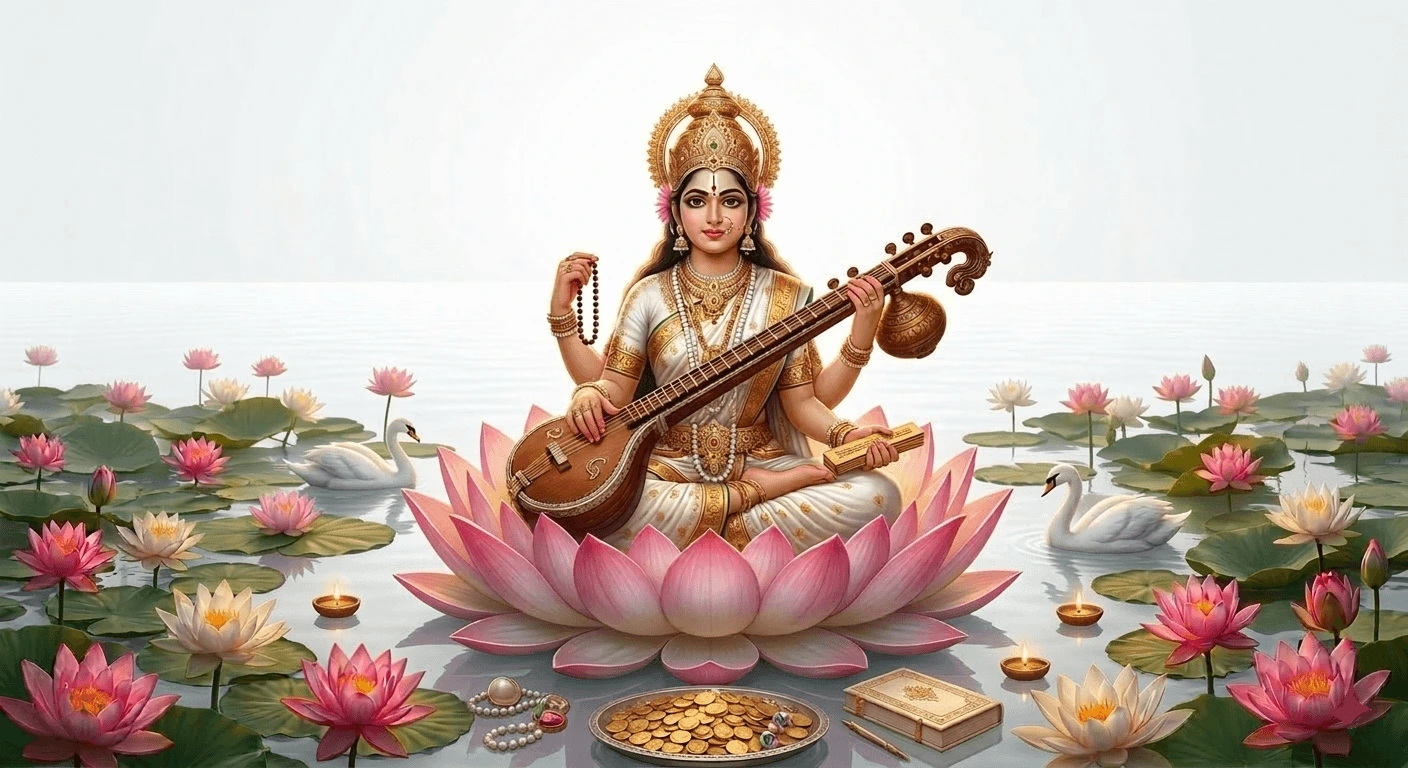
Specialties:
In Hindu Dharma, Goddess Saraswati is worshipped as the presiding deity of knowledge, education, arts, and speech.
Shveta Vastradharini: She wears pure white garments, which symbolize spotless knowledge and purity.
Veena: The Veena in her hand is a symbol of music and rhythm; it represents the 'Nada Brahma' (the divine sound) of the universe.
Akshamala (Rosary): It represents concentration, meditation, and spiritual practice.
Book: The palm-leaf manuscript or book in her hand is the source of all Vedas, sciences, and worldly knowledge.
Parents: Primarily created by Lord Brahma as his daughter (Manasa Putri) to aid in creation. In some traditions, she is an expansion of Adi Parashakti.
Divine Consort: Lord Brahma Dev
Children: Sage Narada is often mentioned as her son in certain Puranic texts. Symbolically, all arts and sciences are considered her offspring.
Siblings: While she doesn't have biological siblings in the human sense, Goddess Lakshmi and Goddess Parvati are considered her sisters as part of the Tridevi. The Manasaputras (mind-born sons) of Brahma are also regarded as her brothers.
Abode: Satyaloka or Brahmaloka.
Vehicle: Swan
Birth Secret:
Mind-Born Daughter of Brahma: According to the Brahmanda Purana, Lord Brahma created Saraswati from his own body/intellect to bring order, knowledge, and speech to a silent and chaotic universe.
The Manifestation of Adi Parashakti: In the Devi Bhagavatam, she is described as one of the three primary forms (Tridevi) that emerged from the Supreme Goddess Adi Parashakti to facilitate the creation, sustenance, and dissolution of the universe.
Festivals of Saraswati:
Vasant Panchami: The most significant festival dedicated to Goddess Saraswati, celebrated as her birthday. It marks the preparation for the arrival of spring. People wear yellow, and it is the most auspicious day for Aksharabhyasam (initiating children into education).
Saraswati Puja (During Navaratri): During the Sharad Navaratri (Dussehra), specifically on the day of the Moola Nakshatra, she is worshipped with great devotion.
Jnana Panchami: Observed in the month of Karthika (primarily in Jain tradition), this day is dedicated to honoring knowledge and holy scriptures.
Death:
Eternal Knowledge: Since she is the personification of knowledge, and knowledge has no end, she exists as long as the universe exists.
Cyclic Existence: During Mahapralaya (the great dissolution), all deities merge back into the Supreme Consciousness or the Creator. When a new cycle of creation begins, she manifests again to guide the process of knowledge and creation.
Biography: She is the mind-born daughter of Lord Brahma. When Brahma created the universe, it was silent and static. Through his divine thought, he manifested Saraswati. As she played her Veena, the universe was filled with sound (Omkara) and life. She represents the flow of wisdom. While Brahma is the Creator, Saraswati provides the intellect, discipline, and creativity required for creation. As the Goddess of Speech, she is known as 'Vak Devi'.
Legend states she also manifested as the Saraswati River, which was the cradle of Vedic civilization. It is believed that the river later went underground (Antarvahini). At Prayag (Allahabad), she is said to meet the Ganges and Yamuna invisibly at the Triveni Sangam.
Her influence extends beyond Hinduism; she is revered as a deity of wisdom in Buddhism and Jainism as well. In Japan, she is worshipped as Benzaiten, the goddess of everything that flows (water, time, words, and music).