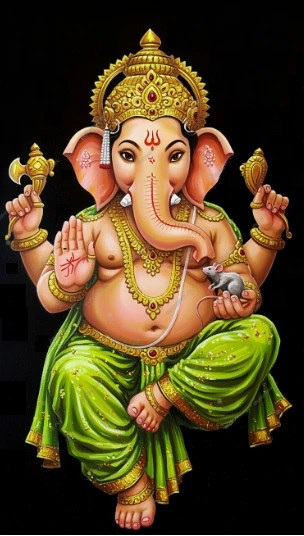
Lord Ganesha
Specialties:
No matter who is worshipped or what auspicious work is started, the first worship is done to Ganesha. This is a boon he received from Shiva. That is why he is called 'Agra Pujya'. He is the one who creates and removes obstacles. His specialty is to remove obstacles in the work we do and achieve success. If Veda Vyasa is narrating the Mahabharata, then Ganesha is the great writer who turned his tusk into a pen and wrote it. This is a testament to his intelligence and dedication.
Famous Temples :
1) Ashtavinayak Kshetra (Maharashtra). 2) Kanipakam Varasiddhi Vinayaka Swamy (Andhra Pradesh)
Pleasing to Lord Ganesha:
Durva Grass (garika): Offering 21 blades of Durva grass is considered highly auspicious and sacred during his worship.
Modaks and Undrallu: Modaks and jaggery-based Undrallu (steamed rice balls) are his most favorite food offerings (Naivedyam).
Red Flowers: He is particularly fond of red flowers, especially the Hibiscus (Mandara).
Shami Leaves: Worshipping him with Shami (Jammi) leaves is believed to remove obstacles from one's path.
Kudumulu: These are traditional rice-flour dumplings that are considered very dear to him.
Wood Apple and Jamun: The Wood Apple (Velagapandu) and Rose Apple/Jamun (Neredu) are mentioned in the Puranas as his favorite fruits.
Father: Lord Shiva
Mother: Goddess Parvati
Divine Consorts: Siddhi, Buddhi
Children:
Sons: Shubham (Siddhi), Gaap (Buddhi)
Daughter: Santoshi Mata
Siblings: Kumaraswamy, Ashokasundari
Abode: Swananda Lokam (Special Abode) According to the Ganesha Purana and the Mudgala Purana, Vinayaka has a special abode called 'Swananda Lokam'. This is also known as 'Ganesha Lokam'. It is described as always filled with happiness.
Aliases: We recite 108 names (Ashtottara Shatanamavali) for Vinayaka. Some of the most famous ones are 1). Ganapati 2). Ganesha 3). Vighneshwara 4). Gajanana 5). Lambodara 6). Ekadanta 7). Vakratunda 8). Mushika Vahana 9). Son of Parvati.......
Vehicle: Mouse (Rat)
Weapons: The main weapon in the hand of Lord Ganesha is called 'Pashankusha'. 1). Pashan 2). Ankusha 3). Broken Tusk 4). Parashu 5). Padma
Festivals of Ganesha: Vinayaka Chavithi, a clay idol of Ganapati is installed on the day of Vinayaka Chavithi (Bhadrapada Shuddha Chavithi). The festival lasts for nine days (11 days in some places). On the last day, the idol is immersed in water.
Birth Secret:
According to Hindu tradition, Goddess Parvati created a boy from the sacred turmeric paste (or from the substance of her body, according to different traditions) and gave him life. She instructed him to guard the entrance while she was bathing.
When Lord Shiva arrived and tried to enter, the boy stopped him, as he was following Goddess Parvati's command. Lord Shiva became angry, and a fierce battle took place between Shiva's attendants and the boy. Finally, Lord Shiva severed the boy's head.
Seeing this, Goddess Parvati became deeply sorrowful and angry. She asked Lord Shiva to restore the boy's life. Lord Shiva then instructed his attendants to bring the head of the first living being they encountered facing north. They found an elephant, and its head was brought to Lord Shiva.
Lord Shiva placed the elephant's head on the boy's body and restored his life. He then blessed him and declared that he would be worshipped first before beginning any auspicious activity.
Death: In Hinduism, gods and goddesses do not die like humans, but rather they transform from one form to another or become immortal. The Puranas say that Lord Ganesha reaches his divine abode after completing his work.
Biography:
According to traditional accounts, Gajasura was a powerful elephant-headed demon who performed severe penance and received a powerful boon from Lord Shiva. As part of his boon, Gajasura asked Lord Shiva to remain within his body. Lord Shiva entered Gajasura's belly and remained there. Goddess Parvati became concerned upon hearing this and prayed to Lord Vishnu for help. Lord Vishnu then assumed the form of a decorated Gangireddu and approached Gajasura. Through his divine plan, Lord Vishnu helped bring about the release of Lord Shiva. Realizing the divine plan, Gajasura understood that his life was nearing its end. He surrendered himself to Lord Shiva and requested that his head be remembered and honored after his death. He also requested that his skin be worn by Lord Shiva. Lord Shiva granted his wishes. When Goddess Parvati went to take a bath, she created Ganesha from turmeric paste and appointed him as her guard. When Ganesha stopped Lord Shiva from entering, Shiva became angry and severed his head. At Goddess Parvati's request, Lord Shiva later placed an elephant's head on Ganesha's body and restored him to life. Lord Shiva then blessed Ganesha and declared that he would be worshipped first before the beginning of any auspicious activity. Thus, Ganesha became known as the remover of obstacles and the foremost deity to be worshipped. According to another traditional account, Lord Shiva and Goddess Parvati wanted to determine which of their sons, Ganesha or Kumaraswamy, was wiser. They proposed that whoever could circumambulate the world and return first would be considered the winner. Kumaraswamy immediately set out on his peacock and travelled around the world. Ganesha, understanding the deeper significance of his parents, circumambulated Lord Shiva and Goddess Parvati three times and explained that his parents represented the entire universe to him. Pleased with Ganesha's wisdom and devotion, Lord Shiva and Goddess Parvati declared him the winner. This story is traditionally regarded as a symbol of Ganesha's wisdom, devotion, and deep understanding of his parents.